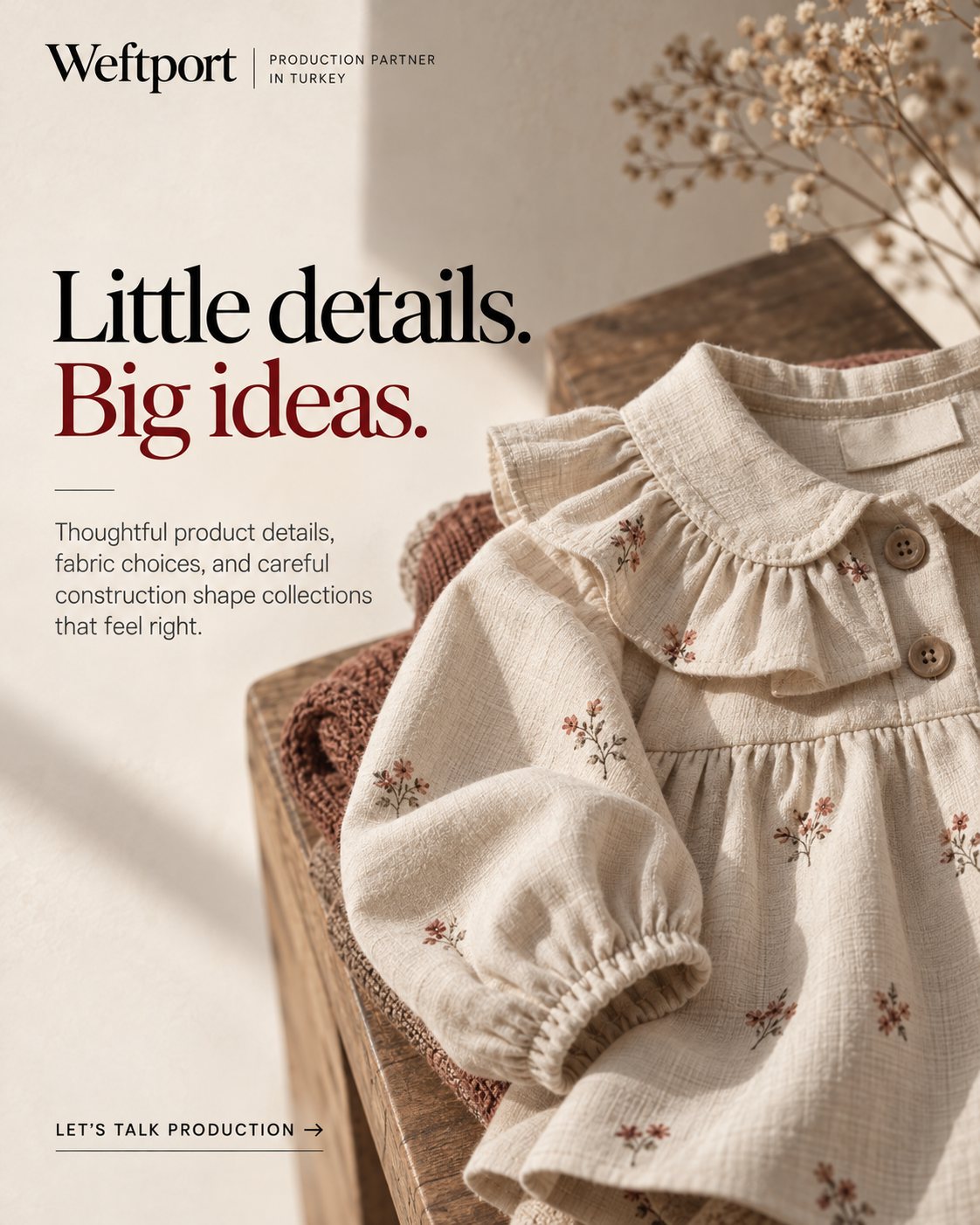
Kidswear is about 10 percent of the production at our partner factory in Istanbul, and it is the category where small decisions matter most. A button that is slightly too large, a seam that rubs, a neckline that is hard to pull over a head: parents notice immediately. This guide covers how to plan a children's collection for custom production, from fabric to trims to checks.
Start with the child, not the garment
Children's clothing has to work for movement, dressing and washing. Before you sketch, think about how the garment will be used. Will a parent dress a toddler lying down? Does a school-age child need to manage closures alone? Will the piece be washed weekly? The answers shape fabric, closures and fit.
Sizing is also different. Children's sizes follow age or height bands, and growth room is expected. Provide a measurement chart for each size band and state clearly whether you want a relaxed or close fit.
Fabric choices
Soft handfeel, stability after wash and colour that does not transfer are the main priorities. Woven cottons and cotton blends, jersey knits and knitted structures such as rib or waffle are common in children's collections. Because kidswear is washed often, check dimensional stability and appearance after wash. Both are part of the quality workflow at our partner factory, along with colour fastness and rubbing fastness (wet and dry).
Prints and embroidery deserve extra thought. Place them where they will not irritate the skin, and think about how a design behaves through repeated washing.
Trims and closures
Buttons, snaps, zips, ribbons and elastics need the most attention. Our quality workflow includes a 90 N test for buttons and snaps, which checks that they stay attached under pulling force. For your own market, confirm what rules and standards apply to children's clothing, for example regarding drawcords, small parts and labelling, and share them with the factory before sampling. Rules differ between the UK and the EU, and you remain responsible for compliance in your market.
Keep trims simple. A button placket with fewer buttons, a soft elastic waist or a snap closure can make a garment easier to use and safer to produce.
Construction details that make a difference
- Seams should lie flat and avoid rubbing at the neck, underarm and waist.
- Labels are better printed or attached so they do not scratch. Specify placement.
- Necklines need enough stretch or an opening to pass over a head easily.
- Hems and cuffs can include a little extra length for growth.
- Ruffles, collars and gathers add charm but also complexity. Specify how much fullness you want.
Sampling kidswear
Check the sample on a child of the right size if you can, or on a size-appropriate form. Test how easy it is to put on and take off. Wash it once, then check measurements and appearance again. Compare with your fabric and colour approval. If you are developing several sizes, agree which sizes will be sampled; usually one or two reference sizes are enough for the first round, followed by the full size set after approval.
Quantities and styles
Projects start from 500 pieces and there is no upper limit. For kidswear, think about how the quantity splits across sizes: smaller size bands may sell faster or slower than larger ones depending on your customer. Confirm the split before cutting.
Presentation and packing
Parents and gift buyers care about presentation. Think about folding, tissue, hangtags and carton labelling. A well-presented small garment sells better. Send your packing requirements early.
A kidswear checklist before sampling
Before you send the brief, run through a short list. Are size bands and measurements defined for each band? Is every trim chosen with a child's use in mind, and have you checked the rules that apply in your market? Are labels placed so they will not scratch? Is the fabric tested for appearance after wash and colour fastness? Have you decided how the garment is packed and presented? Answering these before the first sample removes most of the corrections that otherwise cost a whole sampling round. Add a photo of any reference garment, and mark the details you like or want to change.
Next step
See how production fits together on the process page, review our collections or contact us with your category, estimated quantity and sketches. Our guide to the five-step process explains what happens after you send your brief.
FAQ
Do you produce kidswear?
Yes, kidswear is about 10 percent of our partner factory's production.
Are buttons tested?
The quality workflow includes a 90 N test for buttons and snaps. Rules for your own market remain your responsibility, so share them with the factory early.
What is the minimum quantity?
Projects start from 500 pieces, with no upper limit.