Skip to content
Resources

Size charts &tech pack kit.

Reference tables, a blank tech pack, a filled example and a checklist. Everything you need to write a brief that factories can price and sample accurately.

Resources

What is inside

  1. Size chartsReference body measurements for women, men and kids, plus measurement points per garment type (XLSX).
  2. Tech pack templateBlank tech pack in six sheets: cover, measurements, materials, construction and labels, packing, colourways (XLSX).
  3. Example tech packA filled example for a fictional trouser, so you can see the level of detail that works (PDF).
  4. Tech pack checklistOne page to run before you send a brief (PDF).
  5. Sample review sheetA template to give structured, numbered feedback on a sample (XLSX).
01

Reference size charts

Rounded body measurements in cm. Use them as a starting point for a conversation, not as a replacement for your own fit block or an approved sample.

Women · EU / UK / US · body measurements (cm)
EUUKUSBustWaistHip
3462806288
3684846692
38106887096
401289274100
4214109678104
44161210082108
46181410486112
Men · body measurements (cm)
SizeChestWaistHip
S948298
M10088104
L10694110
XL112100116
XXL118106122
Kids · by height (cm)
HeightApprox. ageChestWaistHip
922 y545256
983 y565358
1044 y585460
1105 y605563
1166 y625666
1227 y645769
1288 y675872
1349 y706076
14010 y736280
14611 y766484
15212 y806688
15813 y846892
02

Measurement points

What to specify for each garment type. Tolerances are agreed per point with the factory.

Trousers
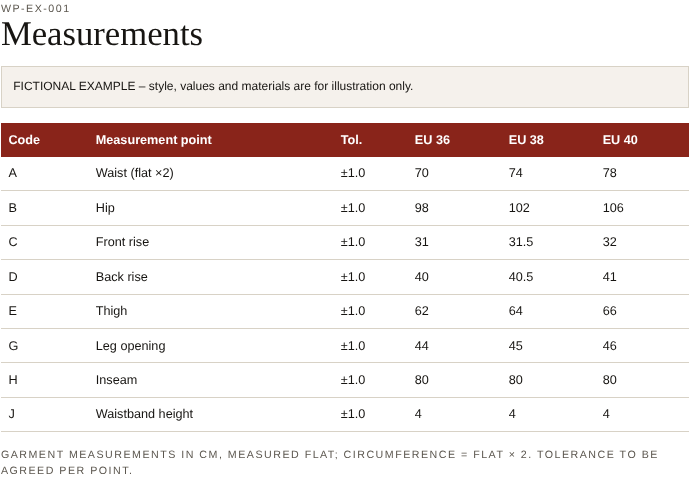
  • A Waist (flat, circumference = ×2)
  • B Hip, at agreed distance below waistband
  • C Front rise (incl. waistband)
  • D Back rise (incl. waistband)
  • E Thigh, at agreed distance below crotch
  • F Knee
  • G Leg opening
  • H Inseam
  • I Outseam
  • J Waistband height
Jackets & coats
  • A Shoulder width (point to point)
  • B Chest, at agreed point below armhole
  • C Waist
  • D Hem width
  • E Centre back length
  • F Sleeve length (from shoulder point)
  • G Bicep
  • H Cuff opening
  • I Lapel width
  • J Pocket position and size
Knitwear
  • A Chest, below armhole
  • B Body length (from high point shoulder)
  • C Shoulder drop
  • D Sleeve length
  • E Bicep
  • F Cuff opening, relaxed
  • G Hem opening, relaxed
  • H Neck opening
  • I Neck / roll-neck height
T-shirts & hoodies
  • A Chest, 2.5 cm below armhole (or as agreed)
  • B Body length (HPS)
  • C Shoulder width
  • D Sleeve length
  • E Bicep
  • F Cuff / sleeve opening
  • G Hem width
  • H Neck width and drop
  • I Hood height and width (hoodies)
Dresses & skirts
  • A Bust
  • B Waist
  • C Hip
  • D Total length (HPS to hem)
  • E Hem sweep
  • F Shoulder / strap width
  • G Sleeve length and opening
  • H Skirt length (waist to hem)
03

Example tech pack

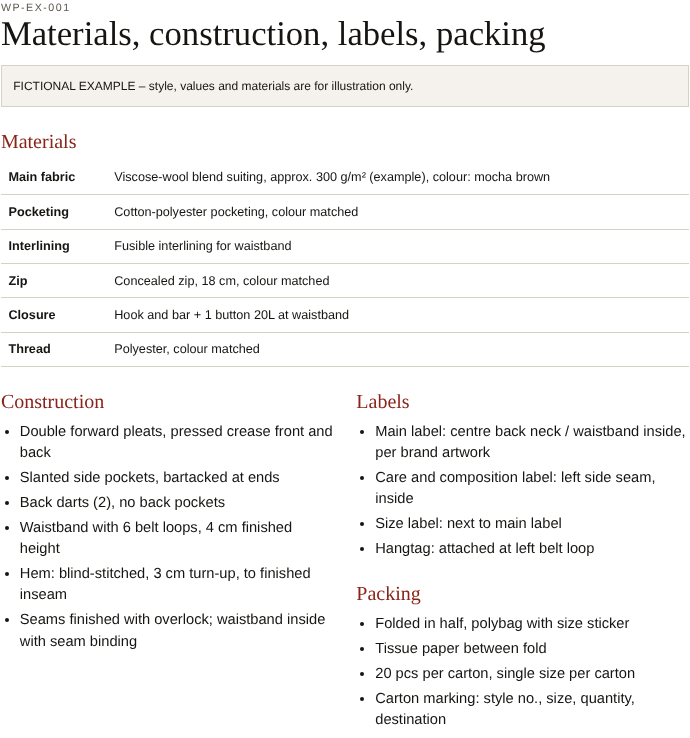
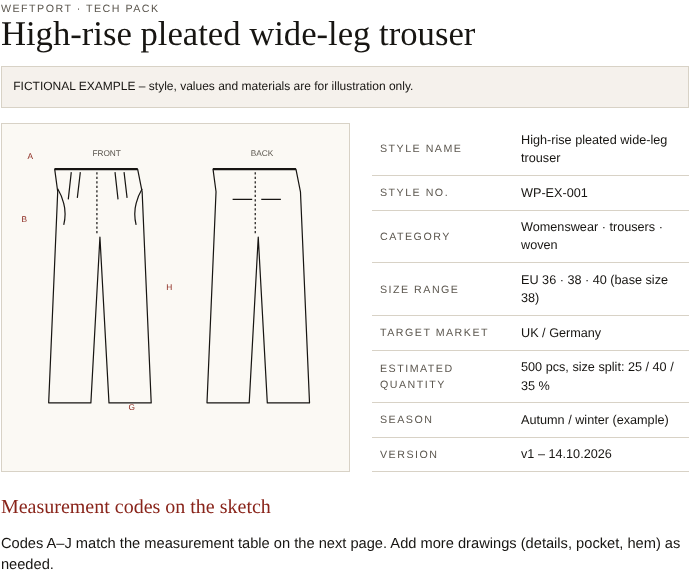
A fictional style, shown in the level of detail that makes quotations and samples more accurate. Download the full PDF in the kit.

Open the example (PDF)
Fictional example for illustration only 1
Fictional example for illustration only · 1/3
Fictional example for illustration only 2
Fictional example for illustration only · 2/3
Fictional example for illustration only 3
Fictional example for illustration only · 3/3
04

Illustrative scenarios

Three composite scenarios that show how decisions are usually made. They are illustrations, not client cases, and no results are implied.

Scenario 1

A young label plans a first capsule

  1. The label has flat sketches, a reference blazer and a fabric idea but no full tech pack.
  2. They send category, an estimated quantity of 500 pieces split across three styles and a target market.
  3. The factory asks for measurements and the fabric direction, then quotes. The label uses the tech pack template to close the gaps.
  4. Two sample rounds are planned for the blazer, one for the knit top and the trouser.
  5. Lesson: a focused range and a consolidated feedback list keep the first project readable.
Scenario 2

A retailer sets up a repeat programme

  1. The retailer buys the same trouser fit across several deliveries.
  2. They keep the approved sample, measurement table and fabric approvals in one folder, with version numbers.
  3. For each reorder they send the same file set and note any change in writing.
  4. Deliveries are compared with the approved sample using the same checklist.
  5. Lesson: documentation turns a one-off order into a repeatable process.
Scenario 3

A kidswear collection with trim-sensitive details

  1. The brand designs a coat with buttons and a knit set with drawcord-free hoods.
  2. Before sampling it checks the rules that apply in its market and shares them with the factory.
  3. Buttons and snaps are specified together with the pull test in the quality workflow.
  4. Size bands and measurements are defined per band, and one reference size is sampled first.
  5. Lesson: safety-relevant details belong in the brief, not in the correction round.

Reference values and the example are for guidance and illustration only. Labelling, safety and compliance rules for your market remain your responsibility.
Ready to send your brief?

Attach what you have and tell us your category, estimated quantity and design direction.

Request a Quote
Work together

Ready to bring yourcollection to life?

Get in touch for a tailored quote and expert guidance on your production in Türkiye.

Request a Quote
Request a Quote