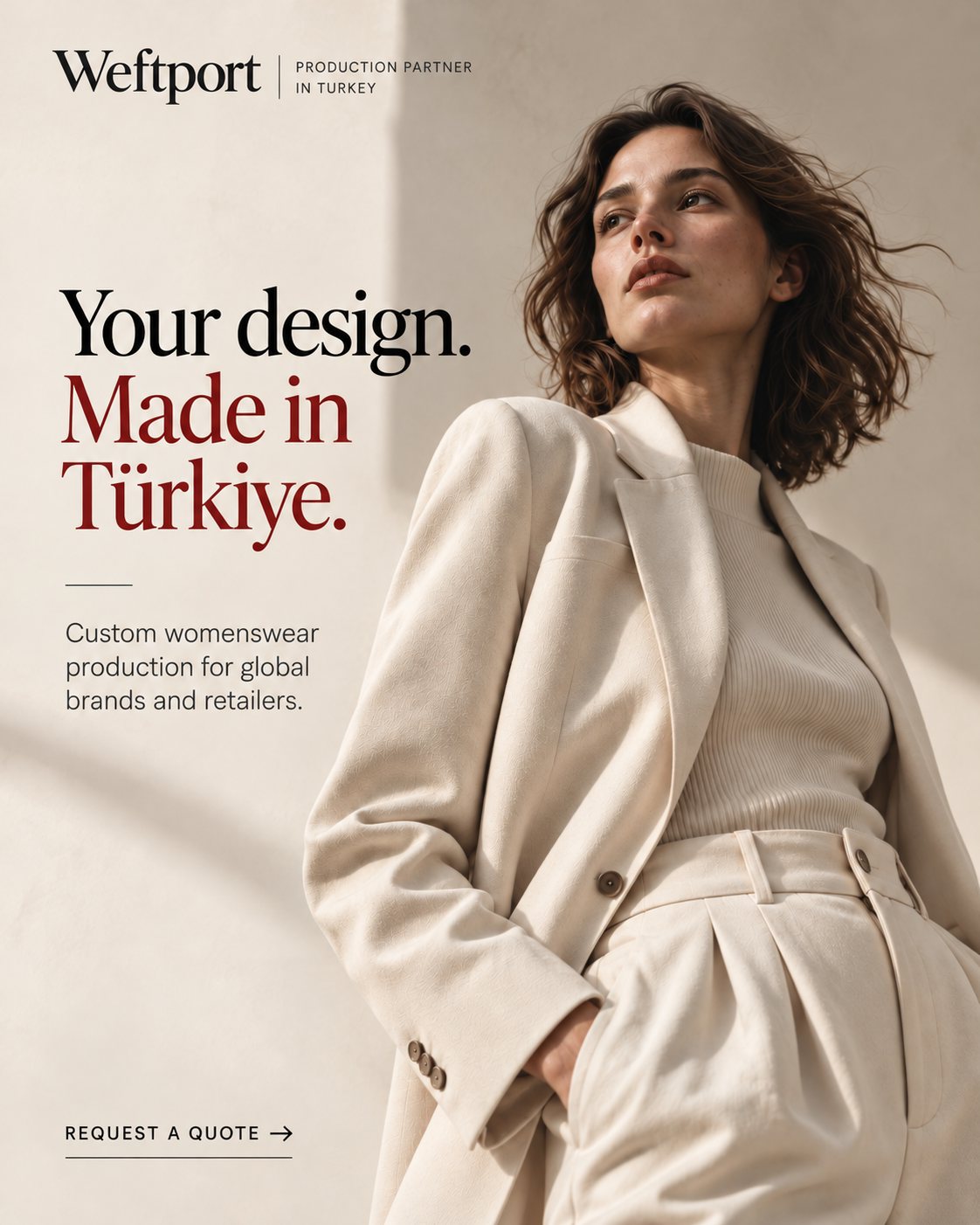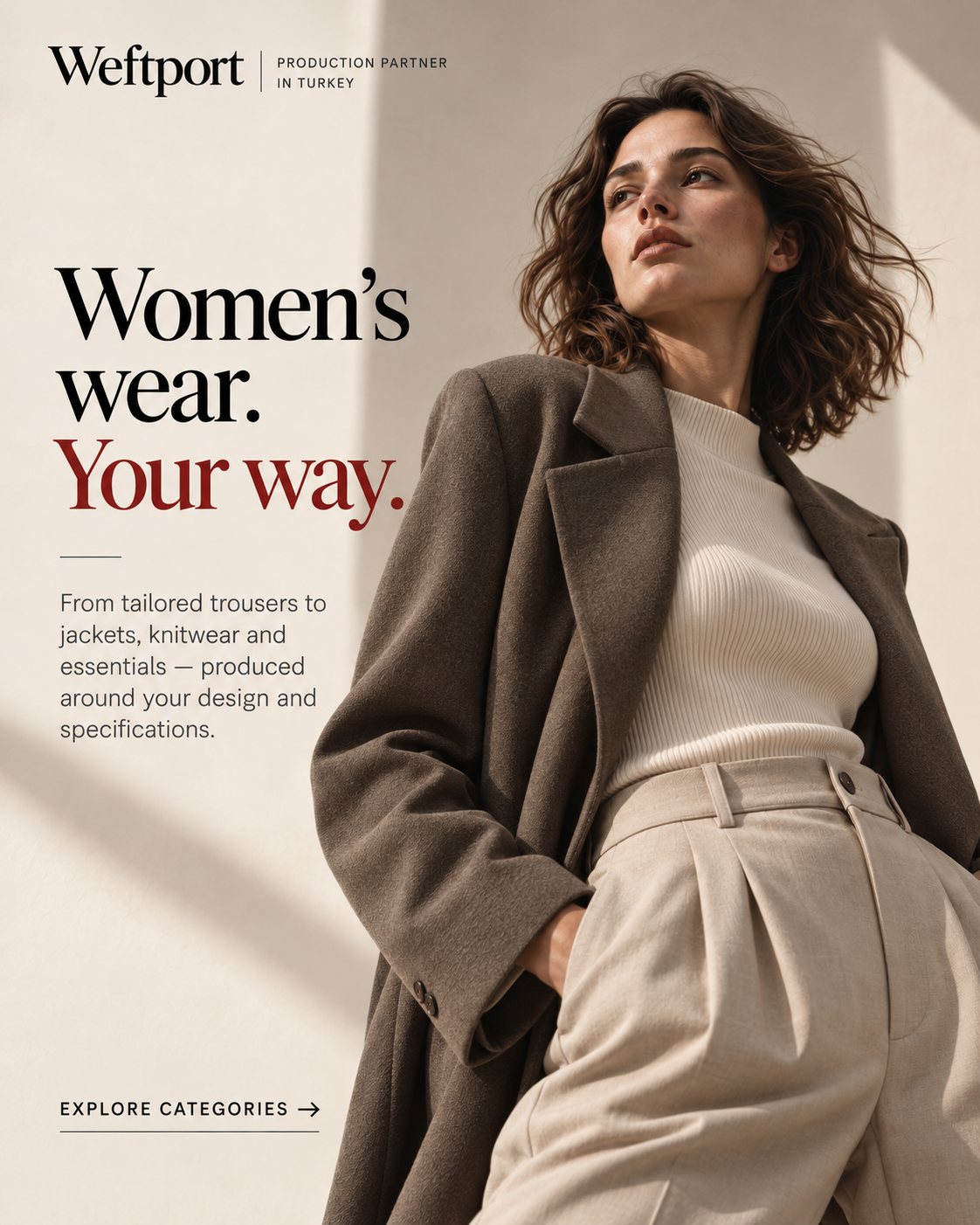
Womenswear makes up about 70 percent of the production at our partner factory in Istanbul, and the range on request is wide. This article explains the main categories, woven and knitted, and what changes in the specification from one to the next. Denim is the one area we do not cover.
Woven or knitted: the first decision
Almost every womenswear style falls into one of two construction families.
Woven garments are cut from fabric made by interlacing warp and weft threads. Trousers, blazers, coats, shirts, skirts and dresses are typical examples. Woven fabric holds a shape well, which is why it is used for tailoring.
Knitted garments are made from fabric (or shaped panels) built from interlocking loops. Jumpers, jersey tops, cardigans and knit dresses are typical. Knits stretch and recover, so fit works differently and sizing is more forgiving.
Deciding early which family a style belongs to helps with fabric choice, measurement tolerances and sampling.
Tailored trousers
Trousers look simple and are among the most demanding styles to get right. Fit through the waist, seat and thigh, the rise, the pleat or dart placement and the hem length all matter. Specify the waist construction, closure, pocket type, lining if any, and the finished inseam per size. A pleated, high-rise trouser needs different pattern work from a straight, flat-front one, so a clear reference image helps.
Jackets, blazers and coats
Outerwear and tailoring involve more components: shell fabric, lining, interlining, shoulder construction, buttons, pockets and often a label inside the collar. Provide details on lapel shape, button count, pocket style and how structured you want the shoulder. Expect more than one sample round, because tailoring is sensitive to small changes. See our note on the first sample.
Knitwear
For knitwear the key variables are yarn composition, gauge, rib structure and finishing. Describe the stitch, neckline, cuff and hem finish. Because fabric and garment are made together, the yarn decision is effectively the fabric decision, so settle it early.
Dresses, skirts and shirts
These are often lighter, more fluid fabrics. Pay attention to drape, transparency, seam finishing and lining. For prints, specify placement and scale. Light fabrics reveal construction flaws, so detail work matters.
Essentials and basics
Basic styles such as simple tops, loungewear and layering pieces are not simple at scale. Consistency across several hundred pieces is the challenge: the same shade, the same measurements, the same handfeel. Colour approval is important here, and our partner factory uses a colour light box to check shades under standard light sources.
What to put in your brief for any category
- Flat sketches front and back, plus any detail drawings.
- A size chart with the sizes you intend to sell.
- Fabric direction: composition, weight, hand and any colour references.
- Trims: buttons, zips, labels, hangtags.
- Estimated quantity per style and the target market.
A complete brief shortens the path to a good first sample. Our tech pack checklist goes through it point by point.
Mixing categories in one order
Many brands combine categories, for instance a blazer, a trouser and a knit top in a capsule. That works well, but remember the minimum of 500 pieces applies to the project, and different fabrics and constructions need separate sampling. Plan your sample schedule around the most complex style.
Choosing the right level of detail
New brands often ask how much to specify. The honest answer is: as much as affects the result. Details that change appearance or fit, such as pleat depth, lapel width, rib structure or hem finish, belong in the brief. Details you have no opinion about can be left to the factory's standard practice, but say so explicitly. This keeps the brief short and avoids a situation where an assumption on either side turns into a surprise in the sample. If you are unsure, include a reference garment: a photograph with measurements marked on it communicates more than a paragraph of description.
Planning the sampling schedule
Different categories need different amounts of sampling. A simple knit top may be approved after one round, while a lined blazer often needs more. Plan the schedule backwards from your delivery window, add time for fabric sourcing, and leave room for at least one correction round on complex styles. Starting with the most demanding style first gives you the most useful learning early.
Where to go next
See what we cover on the collections page, then send your category, quantity and design direction and we will suggest next steps.
FAQ
Which womenswear categories can be produced?
Trousers, jackets, coats, knitwear, dresses, skirts, shirts and essentials, woven or knitted. The range on request is wide, but denim is not included.
Is there a minimum quantity per style?
Projects start from 500 pieces. How the quantity is split across styles is discussed in the quotation.
Do you only make womenswear?
Womenswear is the core, with menswear and kidswear as well.